Good to Great Summary
🔊 Listen to this summary
In short
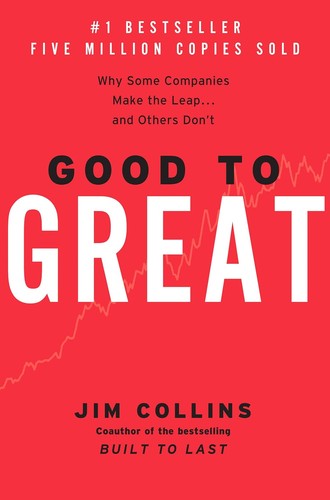
Good to Great asks a simple question: can a good company become a great company, and if so, how? Jim Collins and his research team started with 1,435 companies that had appeared on the Fortune 500, and looked for those that had moved from average results to superior results — defined as cumulative stock returns at least three times the general market over fifteen years — after a period of no better than average performance, and sustained that performance. Eleven companies qualified. The team then spent five years studying those eleven, and a set of comparison companies that failed to make or sustain the leap, reading thousands of articles and generating more than 2,000 pages of interview transcripts. The findings were not a single trick, but a framework: humble yet driven Level 5 leaders, getting the right people first, confronting brutal facts, a simple Hedgehog Concept, a culture of discipline, technology used as an accelerator rather than a driver, and slow, cumulative momentum — the flywheel — rather than a dramatic breakthrough.
Good is the enemy of great — and most companies settle for good without ever noticing. In Good to Great, Jim Collins argues that greatness is not a matter of circumstance, charisma or luck, but largely a matter of conscious choice and disciplined action, repeated over years. The book's evidence comes from a five-year study of companies that did make the leap, and its conclusion is both encouraging and demanding: the leap is possible, but there are no silver bullets, no single heroic programme, and no shortcut around getting the people, the thinking and the discipline right first.
Key takeaways
- Level 5 leadership matters most: the leaders of the good-to-great companies combined personal humility with fierce professional will — ambitious for the institution, not for themselves, crediting others when things went well and taking responsibility when they went wrong.
- First who, then what: get the right people on the bus, the wrong people off, and the right people in the right seats before deciding on strategy — because the right team can adapt to a changing world, while the wrong team cannot execute even a good plan.
- Confront the brutal facts, yet never lose faith: great companies faced their harshest realities honestly, while holding an unwavering belief that they would prevail in the end — a combination Collins calls the Stockdale Paradox.
- The Hedgehog Concept is a simple guiding idea at the intersection of three questions: what you can be the best in the world at, what drives your economic engine, and what you are deeply passionate about.
- The flywheel, not the breakthrough: the transition from good to great comes about by a cumulative process — step by step, action by action, turn by turn of the flywheel — not by one dramatic event, while companies that chase radical change fall into the doom loop.
A study, not a theory
Collins did not start with a theory and look for examples to support it. He started with a dataset. In 1996 his research team screened 1,435 companies that had appeared on the Fortune 500, looking for a sharp, sustained leap to superior performance after a period of average performance. To qualify, a company needed cumulative stock returns at least three times the general market over fifteen years after a transition point. Eleven companies met the test: Abbott Laboratories, Circuit City, Fannie Mae, Gillette, Kimberly-Clark, Kroger, Nucor, Philip Morris, Pitney Bowes, Walgreens and Wells Fargo. The team contrasted them with comparison companies that failed to make the leap, or failed to sustain it.
That method is the book's strength and its limit. Because every concept in the framework appeared in all eleven good-to-great companies and in only a minority of the comparison companies, the patterns are hard to dismiss as coincidence. But the study looks backwards at companies that succeeded, and it cannot prove that following the same steps will produce the same result — especially since several of the eleven later ran into serious trouble, including Circuit City and Fannie Mae, a fact later critics have rightly raised. The book is best read as a disciplined account of what those companies had in common at the time, not as a guarantee.
Level 5 leadership and first who, then what
The book's most surprising finding was about leadership. Collins expected to find charismatic, high-profile chief executives. He found the opposite: the leaders who presided over the transitions were, almost universally, self-effacing, quiet and little known outside their industries. He called them Level 5 leaders — the top of a five-level hierarchy — combining personal humility with ferocious professional will. They channelled their ambition into the institution, looked out of the window to credit others for success, and looked in the mirror to assign responsibility for failure. Ten of the eleven came from inside their companies, not from outside.
The second finding followed from the first: the good-to-great companies started not with a new strategy, but with the right people. "First who, then what" means getting the right people on board, the wrong people off, and the right people in the right seats before deciding where to drive the bus. The reasoning is practical: if you start with who, you can adapt to a changing world, because the right people will find the right direction; if you start with what, you are betting the company on a single idea, and you will struggle to change course when the idea is wrong. Rigorous people decisions — not ruthless ones — are presented as the foundation for everything else.
Brutal facts, the Hedgehog Concept and disciplined action
Once the people were right, the good-to-great companies were distinguished by how they thought. They confronted the brutal facts of their reality — creating a climate in which the truth was heard, asking questions rather than giving answers, and facing difficulties without blame — while never losing faith that they would prevail. Collins names this the Stockdale Paradox, after Admiral James Stockdale, who survived as a prisoner of war by holding both realities at once. The comparison companies, by contrast, tended to avoid uncomfortable truths or to swing between optimism and despair.
From that honest assessment came the Hedgehog Concept: a simple, clear idea that unifies and guides decisions, drawn from the intersection of three circles — what the organisation can be the best in the world at, what drives its economic engine, and what it is deeply passionate about. The fox, in the book's borrowed fable, knows many things; the hedgehog knows one big thing. Discipline then turns the concept into action: a culture in which disciplined people take disciplined action, consistently, without needing heavy-handed control. Technology fits here too — the great companies used new technology as an accelerator of momentum they already had, never as the creator of it, and never chased a technology for its own sake.
The flywheel and the doom loop
The final concept explains why the transition looks so undramatic from the outside. Collins compares the build-up to pushing a heavy flywheel: enormous effort at first, with almost no visible movement, then slow turning, then momentum that builds on itself until breakthrough becomes visible. The good-to-great companies had no single defining moment, no miracle programme, no launch event that explained their rise; the leap was the cumulative result of consistent pushes in a consistent direction. That is why the book warns against looking for a single cause.
The opposite pattern is the doom loop: companies that lurch from one radical programme to another, launch dramatic changes without building understanding, and abandon each initiative before it can accumulate. They chase a breakthrough and, in doing so, prevent one. The flywheel is therefore both a description and a discipline — a reminder that the work that matters is often invisible while it is happening, and that patience is part of the strategy, not a failure of ambition.
Who should read this book
This book is for founders, managers and team leaders who want a research-based framework for building a durable organisation, rather than a collection of motivational stories. It is also useful for anyone in a non-business role — a school, a charity, a public service — who wants to think seriously about leadership, team-building and disciplined execution, since Collins later explored the same ideas for the social sectors. Readers looking for a quick fix, a startup playbook, or a guide to fast growth in a new market will find it slower and more cautious than they expect — and that caution is the point.
The takeaway
Greatness, in Collins's account, is not a single decision but a pattern: humble, determined leadership; the right people first; honest confrontation with reality; a simple idea pursued with discipline; and steady momentum that compounds over years. The leap from good to great is possible — but it is built turn by turn, not bought in one move.
Our verdict
A rigorous, genuinely research-driven classic whose core ideas — Level 5 leadership, first who then what, and the flywheel — have held up well as ways of thinking about organisations. It loses ground because it is a backward-looking study of a specific set of large American companies, because the selection method cannot prove causation, and because some of its eleven exemplars later failed badly, which the book itself could not have foreseen but which limits how literally it can be applied. Our rating: 4.1/5.
Try this today: Write down, in one sentence, what your team or organisation could be the best in the world at — then ask one colleague whether they agree, and what evidence would prove or disprove it.
If you want to go deeper on this theme, Zero to One, The Lean Startup, and Start With Why are the natural next reads.
Frequently asked questions
What is Good to Great about?
It is Jim Collins's five-year study of how good companies become great, based on eleven companies that moved from average stock returns to returns at least three times the market over fifteen years, and sustained that performance.
How many companies were in the study?
Collins's team screened 1,435 companies that had appeared on the Fortune 500 and identified eleven that met the good-to-great criteria, including Abbott Laboratories, Gillette, Kroger, Nucor, Walgreens and Wells Fargo.
What is a Level 5 leader?
A Level 5 leader is the top level in Collins's five-level hierarchy of executive capability: a leader who combines personal humility with fierce professional will, ambitious first for the institution rather than for themselves.
What does "first who, then what" mean?
It means getting the right people on the bus, the wrong people off, and the right people in the right seats before deciding on strategy — because the right team can adapt, while the wrong team cannot execute even a good plan.
What is the Hedgehog Concept?
It is a simple guiding concept at the intersection of three questions: what you can be the best in the world at, what drives your economic engine, and what you are deeply passionate about.
What is the flywheel?
The flywheel is Collins's image for cumulative momentum: consistent pushes in a consistent direction build slowly until breakthrough becomes visible, with no single dramatic event. The opposite is the doom loop of lurching from one radical change to another.
Want the full book?
This summary covers the core ideas — the full book goes much deeper with stories, research, and detail.
Get Good to Great on AmazonAs an Amazon Associate I earn from qualifying purchases.
Your turn
Which idea from this book hit you hardest — and what will you do differently this week because of it? Join the discussion under our 60-second video on YouTube.
Discuss on YouTube
Comments
Share what you thought of this book — good or bad. Sign in with a free GitHub account to comment.
Want a different book summarized? Suggest it here.