The Untethered Soul Summary
🔊 Listen to this summary
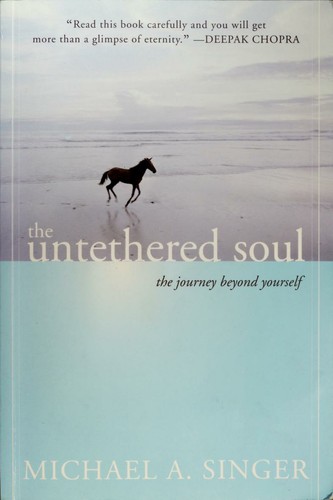
In short
The Untethered Soul is a short spiritual guide built around one question: who are you, really? Michael A. Singer argues that most people mistake themselves for the nonstop voice narrating inside their heads, when in fact they are the awareness that hears that voice. Across five parts and nineteen brief chapters, he explains how unprocessed experiences become stored energy patterns — samskaras — that close the heart and drive reactive behaviour, and how the way out is not to fix the outside world but to relax, let feelings pass through, and stop resisting life. The book ends with unconditional happiness: a peace that does not depend on circumstances, and a frank invitation to contemplate death as a way of living more fully.
What if the voice inside your head — the one narrating, judging, worrying and rehearsing — is not you at all? In The Untethered Soul, Michael A. Singer asks you to notice that voice the way you would notice a talkative roommate, and to realise that the real you is the silent awareness listening to it. From that single shift, he builds a whole path to freedom.
Key takeaways
- You are the witness, not the voice. The constant inner commentary is a mental function, not your identity; freedom begins when you notice the voice instead of automatically believing and obeying it.
- The heart opens and closes. Singer describes inner energy as a flow that opens when you let experience pass through and closes when you resist it; a closed heart is the root of most suffering.
- Stored pain runs your life. Experiences you refused to feel get stored as samskaras — unfinished energy patterns — which later get triggered by small reminders and hijack your mood and reactions.
- Letting go is the only way through. You cannot think your way out of stored pain; you release it by relaxing through discomfort instead of closing around it, and each release burns a little of the pattern away.
- Happiness can be unconditional. Rather than chasing circumstances that make you happy, Singer argues you can choose to keep your heart open and be happy regardless of what happens — and contemplating death sharpens that choice.
The voice inside your head
The book opens with a simple experiment: listen to the voice in your head for a few minutes and notice how it never stops. It narrates what you see, argues both sides of every decision, replays embarrassments and rehearses futures that never happen. Singer calls this voice your "inner roommate" — always talking, never leaving — and points out the strange fact that you can hear it, which means you are not it. The one who hears, the seat of consciousness, is who you actually are, and most suffering comes from forgetting that distinction and identifying with every thought the roommate produces.
This is the foundation of everything that follows, and Singer keeps returning to it in different words. If you are the awareness rather than the content of your mind, then thoughts and emotions become events passing through you rather than orders you must follow. The practice is not to silence the voice by force — that only creates another struggle — but to step back and watch it, the way you would watch weather from a window. Readers who have tried meditation will recognise the move; Singer's gift is stating it so plainly that it lands even for people who have never meditated.
Energy, the heart and the thorn
In the second and third parts, Singer explains the inner mechanics of suffering in terms of energy. The heart, in his language, is an energy centre that can open — letting love, joy and inspiration flow — or close, contracting around whatever feels threatening. Every time you resist an experience instead of letting it pass through, a little of that energy gets blocked and stored as a samskara, an impression that stays lodged inside you. Years later, a smell, a song or a stranger's tone can trigger it, and suddenly you are reacting to the past rather than the present.
His most memorable image for this is the inner thorn: imagine a thorn stuck in your arm, touching a nerve, and imagine arranging your entire life so nothing ever brushes against it. You would avoid crowds, guard your arm, build elaborate protections — and the protections would cost more than the thorn itself. That, Singer says, is how most people live, organising their days around old wounds. The alternative is to stop protecting the thorn and let yourself feel the pain of removing it, which is sharp but brief, and which frees the energy that was tied up in guarding it.
Going beyond: taking down the walls
The fourth part extends the thorn metaphor into a picture of the walls we build. Each stored hurt becomes a brick, and over a lifetime the walls form a cage that feels like safety but is actually a prison — it keeps out pain, but it also keeps out aliveness. Singer argues that spiritual growth is not about adding new beliefs or achievements but about dismantling these walls, letting go of the false solidity of the self-image you have constructed. The chapters here are the most abstract in the book, dealing with identification itself: the sense of being a separate, solid "me" is, in his account, just another pattern that can be seen through and released.
This section is where some readers will part company with the book, because it asks for trust in a framework — energy, samskaras, the seat of consciousness — that cannot be proven in a laboratory. Singer does not argue the case scientifically; he presents it as an invitation to test it in your own experience. That is both the strength and the limit of the approach: it is direct and testable in daily life, but it offers little to a reader who wants evidence or argument before trying the practice.
Living life: unconditional happiness
The final part turns the teaching toward daily living. Singer's most provocative claim is that happiness does not need a reason: you can decide to be happy by keeping your heart open, rather than waiting for circumstances to arrange themselves correctly. The spiritual path, in his telling, is one of nonresistance — consenting to what is happening instead of fighting reality — and the middle way is the balance between indulging every impulse and suppressing every feeling. The chapter on contemplating death is the book's sharpest tool: remembering that life ends, he argues, strips away the trivial anxieties that consume most days and clarifies what actually deserves your energy.
The book closes with a quiet, devotional tone, ending on what Singer calls the loving eyes of God — the idea that a heart fully open experiences the world as love. Whether or not a reader shares that framing, the practical message survives it: stop clinging, stop resisting, and let life move through you. It is a short book with a simple message, and its power comes from repetition and clarity rather than from complexity.
Who should read this book
This book suits anyone feeling trapped by their own thoughts — chronic worriers, overthinkers, people carrying old hurts, and readers curious about meditation or spirituality without wanting a dense philosophical text. It is also a good first step for readers who liked The Power of Now but want something shorter and more conversational.
The takeaway
The Untethered Soul offers one clear practice — notice the voice, open the heart, let go — and repeats it until it becomes usable. It will not satisfy readers who want evidence, exercises or step-by-step technique, but for those willing to try its experiment, it can change how they relate to their own mind.
Our verdict
Beautifully simple and genuinely calming, with an idea — the witness behind the voice — that sticks for years. It loses points for abstraction: the energy framework is asserted rather than argued, and practical guidance is thinner than the philosophy. Our rating: 4.4/5.
Try this today: For two minutes, just listen to the voice in your head without answering it. Each time it starts a sentence, silently note "there's the voice again" — and notice the quiet awareness doing the noticing.
If you want to go deeper on this theme, The Almanack of Naval Ravikant, Meditations, and Man's Search for Meaning are the natural next reads.
Frequently asked questions
When was The Untethered Soul published?
It was published on 3 October 2007 by New Harbinger Publications, co-published with the Institute of Noetic Sciences (Noetic Books).
What is the "inner roommate"?
Singer's name for the nonstop voice inside your head that narrates, judges and worries. His point is that you are the awareness hearing the voice, not the voice itself.
What is a samskara?
A stored, unfinished energy pattern — an experience you resisted instead of letting pass through — that later gets triggered and drives reactive behaviour.
How long is the book?
The original paperback is around 200 pages, organised into five parts and nineteen short chapters.
Is The Untethered Soul a New York Times bestseller?
Yes — it is a #1 New York Times bestseller, and recent editions of the cover state that more than 3 million copies have been sold.
Who is Michael A. Singer?
An American spiritual teacher and author, also known for The Surrender Experiment, his memoir about letting life unfold without resistance.
Want the full book?
This summary covers the core ideas — the full book goes much deeper with stories, research, and detail.
Get The Untethered Soul on AmazonAs an Amazon Associate I earn from qualifying purchases.
Your turn
Which idea from this book hit you hardest — and what will you do differently this week because of it? Join the discussion under our 60-second video on YouTube.
Discuss on YouTube
Comments
Share what you thought of this book — good or bad. Sign in with a free GitHub account to comment.
Want a different book summarized? Suggest it here.