Breath Summary
🔊 Listen to this summary
In short
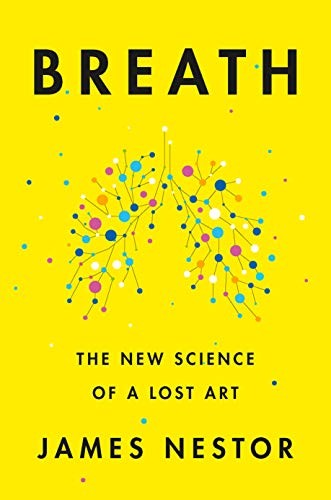
Breath argues that breathing is a neglected lever on health, as important as diet or exercise, and that most modern people do it badly: through the mouth, too fast, and too much. James Nestor, a science journalist, spent about a decade investigating the subject, travelling to meet researchers, breathing practitioners and freedivers, and taking part in a Stanford experiment in which he breathed only through his mouth for ten days, then only through his nose for ten days. The book's core prescription is simple: breathe through the nose, breathe slowly — around 5.5 breaths a minute, with roughly equal in-breaths and out-breaths — breathe less, and exhale fully. Along the way it explores why human jaws and airways have narrowed, how carbon dioxide helps release oxygen to tissues, and how older breathing practices from different traditions converge on similar rhythms.
You take roughly 25,000 breaths a day — so why would how you take them matter? In Breath, James Nestor argues that it matters a great deal, because modern humans have quietly lost the ability to breathe properly, and the consequences show up as snoring, sleep apnoea, high blood pressure, anxiety and crooked teeth. His answer is not a gadget or a drug, but a return to something ancient and free: breathing through your nose, slowly, and less than you think you need to.
Key takeaways
- Breathe through your nose: the nose filters, warms, humidifies and pressurises air, and nasal tissue produces nitric oxide, which helps widen blood vessels and improve oxygen uptake — benefits mouth breathing bypasses.
- Slow down to about 5.5 breaths a minute: an in-breath of about 5.5 seconds and an out-breath of about 5.5 seconds is a rhythm found across prayer, yoga and meditation traditions, and is linked in research cited by Nestor to calmer heart rate, blood pressure and breathing.
- Breathe less, not more: over-breathing flushes out too much carbon dioxide, and because carbon dioxide helps release oxygen from haemoglobin to tissues, breathing too much can paradoxically reduce oxygen delivery.
- Exhale fully: a long, complete exhale helps empty the lungs, strengthens breathing and makes the next breath more efficient, rather than stacking shallow breaths on top of stale air.
- Chew, and keep the mouth closed: Nestor links soft modern diets and mouth breathing to narrower jaws and crowded airways, and argues that chewing harder foods and keeping the mouth shut help maintain the structures that support good breathing.
We have forgotten how to breathe
Nestor's starting point is history. Drawing on studies of ancient skulls, he argues that earlier humans had wide, forward-set jaws, straight teeth and clear airways, while modern skulls show narrower faces, crowded teeth and smaller airways. He links that change to softer, processed diets that require less chewing, and to a shift toward mouth breathing in childhood. The result, in his account, is a population that snores, grinds its teeth, sleeps badly and struggles with congestion — and treats each symptom separately, without asking whether the breathing itself is part of the cause.
That historical argument sets up the book's central claim: breathing is not automatic in the sense of being automatically optimal. Like posture or diet, it is a habit shaped by environment, and it can be retrained. Nestor is a journalist rather than a clinician, and he presents the story as an investigation — meeting orthodontists, ear, nose and throat specialists, pulmonologists and freedivers — rather than as a medical textbook, which is part of why the book reads as a journey as much as an argument.
The Stanford mouth-breathing experiment
The most striking section of the book is Nestor's self-experiment at Stanford, supervised by rhinologist Dr Jayakar Nayak. For ten days, Nestor and breathing therapist Anders Olsson had their nostrils plugged and taped shut, forcing them to breathe only through their mouths, with their health tracked throughout. Then they reversed it: ten days of nasal-only breathing, including tape over the mouth at night. During the mouth-breathing phase, Nestor's blood pressure rose, his snoring increased dramatically, sleep apnoea events multiplied, heart-rate variability fell, and he felt exhausted and foggy.
When the pair switched back to nasal breathing, those effects reversed: blood pressure fell, snoring and apnoea largely disappeared, sleep improved, and energy returned. Nestor presents this as a demonstration with a sample of two, not a clinical trial, and careful readers should treat it that way — but as a vivid illustration of how quickly the route air takes can change measurable markers, it is hard to forget. The experiment is the book's evidence that the nose is not a minor detail; it is part of the breathing system itself.
The perfect breath: slow, nasal, and less
From the research he gathered, Nestor identifies a pattern that recurs across traditions: a slow, even rhythm of about 5.5 breaths a minute. He cites research by Luciano Bernardi, who found that reciting the rosary or a yoga mantra slowed breathing to about six breaths a minute and brought heart rate, blood pressure and brain blood flow into a shared rhythm. Nestor calls the 5.5-second in-breath and 5.5-second out-breath the "perfect breath", and notes that different prayer and meditation practices converged on it independently.
Underneath that rhythm is a counterintuitive lesson about carbon dioxide. Many people assume the urge to breathe comes from a lack of oxygen, but Nestor explains that it is mainly driven by rising carbon dioxide, and that carbon dioxide is needed for oxygen to be released efficiently to tissues. Breathing fast and shallow, especially through the mouth, blows off too much carbon dioxide and can narrow blood vessels. That is why several techniques in the book — including the Buteyko method, which trains people to breathe less and tolerate more carbon dioxide — aim at breathing less, not more.
A toolkit, not a single technique
The second half of the book surveys a range of named breathing practices, explaining the physiology behind each rather than simply prescribing them. They include coherent or resonant breathing at the 5.5-second rhythm, alternate-nostril breathing, box breathing, the 4-7-8 pattern, breathing-coordination exercises, and the more intense practices of Tummo and Holotropic Breathwork, which Nestor reports on but does not present as everyday tools. He also covers chewing harder foods, maintaining nasal breathing during exercise, and taping the mouth at night — a practice some readers try for snoring, which the book discusses in the context of the Stanford experiment.
The breadth is both a strength and a weakness. Readers come away with several concrete things to try, and a clear sense of which technique suits which goal — calming down, improving sleep, or building carbon-dioxide tolerance. But some of the more dramatic claims, especially around the extreme practices, rest on thinner evidence than the core advice about nasal and slow breathing, and Nestor's enthusiasm sometimes runs ahead of the research he cites. The book is best read as a well-reported case for taking breathing seriously, not as a prescription for any medical condition.
Who should read this book
This book is for anyone who snores, wakes unrefreshed, breathes through their mouth, or feels anxious and wired without an obvious cause — and for readers curious about how a basic, overlooked function can affect sleep, blood pressure and energy. It will appeal to people interested in health, sleep and performance, and to anyone who likes science journalism built around a personal experiment. It is not a substitute for medical advice: anyone with sleep apnoea, asthma or another breathing condition should talk to a clinician rather than treating the book as a treatment plan.
The takeaway
Breathing is not just something your body does in the background; how you breathe — nose or mouth, fast or slow, shallow or full — changes how you sleep, how calm you feel, and how efficiently oxygen reaches your tissues. The simplest version of the book's advice is easy to remember: close your mouth, slow down, and exhale fully.
Our verdict
A fascinating, well-reported and highly readable investigation that makes a strong case for a simple, free habit most readers can test the same evening. It loses ground where Nestor leans on a two-person self-experiment and on striking anecdotes for claims that deserve larger studies, and some of the extreme breathing practices are reported with more enthusiasm than caution. Our rating: 4.3/5.
Try this today: For five minutes this evening, sit comfortably, close your mouth, and breathe in through your nose for about 5.5 seconds and out through your nose for about 5.5 seconds, keeping the breaths slow, quiet and even.
If you want to go deeper on this theme, Why We Sleep, Outlive, and The Body Keeps the Score are the natural next reads.
Frequently asked questions
What is Breath about?
Breath is James Nestor's investigation into how humans lost the ability to breathe properly, and how breathing through the nose, more slowly and less, can improve sleep, blood pressure, anxiety and overall health.
What is the 5.5 breaths per minute idea?
It is the rhythm Nestor identifies across prayer, yoga and meditation traditions: an in-breath of about 5.5 seconds and an out-breath of about 5.5 seconds, or about 5.5 breaths a minute, which research he cites links to calmer heart rate and blood pressure.
Why does Nestor say to breathe through your nose, not your mouth?
The nose filters, warms, humidifies and pressurises air, and nasal tissue produces nitric oxide, which helps widen blood vessels and improve oxygen uptake. Mouth breathing bypasses those mechanisms and, in the Stanford experiment he took part in, was linked to worse snoring, sleep apnoea and blood pressure.
What happened in the Stanford experiment?
Nestor and Anders Olsson breathed only through their mouths for ten days, then only through their noses for ten days, under the supervision of rhinologist Dr Jayakar Nayak. Mouth breathing worsened blood pressure, snoring and sleep apnoea; nasal breathing reversed those effects. It was a two-person demonstration, not a clinical trial.
What is the Buteyko method?
It is a breathing method, developed by a Ukrainian doctor, that trains people to breathe less — reducing breathing volume to raise carbon-dioxide tolerance — and which Nestor reports has shown benefits for people with asthma.
Is Breath medical advice?
No. Nestor is a science journalist, not a clinician, and the book is an investigation, not a treatment plan. Anyone with a breathing or sleep condition should seek advice from a qualified clinician.
Want the full book?
This summary covers the core ideas — the full book goes much deeper with stories, research, and detail.
Get Breath on AmazonAs an Amazon Associate I earn from qualifying purchases.
Your turn
Which idea from this book hit you hardest — and what will you do differently this week because of it? Join the discussion under our 60-second video on YouTube.
Discuss on YouTube
Comments
Share what you thought of this book — good or bad. Sign in with a free GitHub account to comment.
Want a different book summarized? Suggest it here.