Stolen Focus Summary
🔊 Listen to this summary
In short
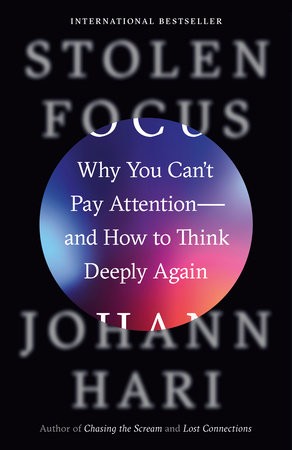
Stolen Focus argues that the collapse of our attention is not a personal failing but a systemic crisis. Over three years, journalist Johann Hari interviewed more than 200 experts — neuroscientists, psychologists, tech insiders and teachers — and concluded that twelve distinct forces, from surveillance-capitalism business models to sleep deprivation and polluted air, are eroding our ability to concentrate. The book's core claim is that willpower alone cannot fix a problem engineered at scale, so real solutions have to mix personal habits with collective change. It is part investigation, part manifesto, and it ends with a call to reclaim attention as a shared resource rather than a private struggle.
Have you ever sat down to read a book and found yourself checking your phone before the end of the first page? Johann Hari had the same problem — and his answer, in Stolen Focus, is that your attention was not lost, it was stolen: by companies, systems and habits that profit from your distraction, and by a modern life that leaves your brain exhausted, overstimulated and starved of the conditions deep focus needs.
Key takeaways
- Losing focus is not a character flaw. Hari's central reframe is that attention is collapsing across whole populations at once, which points to environmental and systemic causes rather than individual weakness.
- The attention economy runs on theft. Tech companies make money by capturing and selling human attention, so their products are deliberately designed to interrupt, hook and fragment it.
- Twelve forces are at work, not one. Speed and constant switching, the loss of flow states, exhaustion, the decline of sustained reading, disrupted mind-wandering, manipulative technology, cruel optimism, stress, diet, pollution, ADHD and the confinement of children all contribute.
- Flow needs protection. Deep, absorbing focus only happens in long, uninterrupted stretches on a single meaningful task — exactly the conditions modern work and phones destroy.
- Personal fixes help, but they are not enough. Sleeping properly, reading books and putting the phone away matter, yet Hari argues the crisis also needs collective action — from schools and workplaces to regulation of attention-harvesting design.
It's not your fault — but it is your problem
Hari opens with his own humiliation: a successful writer who could no longer read a book without his mind wandering, and who blamed himself for laziness. His attempt at a cure was drastic — three months alone on a remote cape in Provincetown, Massachusetts, with no phone or internet. The isolation helped briefly, but the focus returned only until ordinary life resumed, which convinced him the problem was bigger than his habits. That personal story sets up the book's argument that millions of people are failing the same test at the same time, and that a shared failure needs a shared explanation.
The explanation he builds is deliberately wide. Rather than settling on phones as the single villain, he maps a dozen overlapping causes, and shows how each one chips away at a different part of attention — speed trains the brain to expect novelty every few seconds, exhaustion leaves nothing in reserve, and stress keeps the mind in a state of vigilance that makes settling into anything feel unsafe. The point is not that every cause matters equally for every person, but that the crisis is overdetermined: remove one cause and the others keep working.
The business model that profits from your distraction
The most argued section of the book is its account of surveillance capitalism. Hari interviews former tech insiders, including ex-Google design ethicist Tristan Harris, who explain that platforms do not sell products to users — they sell users' attention to advertisers. The longer you stay, the more ads you see and the more data you generate, so every notification, autoplay and infinite scroll is a feature of the business model, not an accident. This framing is what makes the book feel different from ordinary digital-detox advice: the enemy is not the phone in your pocket, it is an industry whose revenue depends on you never looking away.
Hari is careful to show that this is not a conspiracy theory but an incentive problem. Designers and engineers are rewarded for engagement metrics, and the psychological tricks that raise those metrics — variable rewards, social validation, fear of missing out — are well documented in behavioural science. Understanding that design, he argues, is the first step to resisting it, because it replaces self-blame with a clear-eyed view of what you are up against every time you unlock your screen.
Flow, reading and the quiet work of the mind
Several of the twelve causes concern things that have quietly disappeared from modern life: the capacity to enter flow, the habit of sustained reading, and the space for mind-wandering. Flow — the state of total absorption in a challenging, meaningful task — needs long stretches of uninterrupted time, and Hari shows how open-plan offices, constant messaging and task-switching make it nearly impossible. Reading matters for a similar reason: following a long argument through a book trains the brain to hold a single thread, and as skimming headlines replaces deep reading, that capacity atrophies.
Mind-wandering gets its own defence. Far from being wasted time, daydreaming is when the brain makes connections, consolidates memories and solves problems in the background, and Hari argues that filling every idle moment with a feed starves that process. The same logic applies to sleep, diet and stress: a tired, undernourished, anxious brain simply cannot pay attention well, however strong its owner's willpower. These chapters are the book's most practical ones, because they point at changes — real sleep, real books, real boredom — that anyone can start testing immediately.
What reclaiming focus actually takes
The final part of the book turns from diagnosis to prescription, and here Hari splits his answer in two. On the personal side, he recommends the unglamorous basics: protect sleep, read for sustained stretches, create phone-free blocks of time, and deliberately seek out flow by choosing one meaningful task and giving it your full attention. He is honest that these help — his own focus improved when he practised them — but he is equally blunt that they are insufficient on their own, because the forces arrayed against attention are structural.
So the book closes with collective proposals: schools that protect children's free play and limit screens, workplaces that replace constant interruption with focused work time, and public pressure on tech companies to change designs that harvest attention. Readers looking for a tidy ten-step plan may find this ending frustrating, but it follows logically from the argument. If attention was stolen by systems, Hari insists, it has to be reclaimed by changing those systems — and the first step is refusing to believe the theft was your fault.
Who should read this book
Anyone who feels their concentration slipping — students, writers, parents, office workers and anyone who reaches for their phone without deciding to — will recognise themselves in this book. It is especially useful for readers who have tried digital-detox tips and found them useless, because it explains why willpower alone keeps failing and offers a bigger frame for the problem.
The takeaway
Stolen Focus reframes distraction as a systemic theft rather than a personal defect, and backs that claim with twelve well-documented causes. Its message is both relieving and demanding: stop blaming yourself, start protecting the conditions your attention needs, and push for changes bigger than your own habits.
Our verdict
A gripping, humane investigation that turns a familiar frustration into a serious public argument — but not every one of its twelve causes is equally well evidenced, and the policy solutions at the end feel thinner than the diagnosis. Our rating: 4.2/5.
Try this today: Put your phone in another room for one hour and read a physical book for twenty uninterrupted minutes — notice how hard the first five minutes feel, and how much easier the last five become.
If you want to go deeper on this theme, Deep Work, Four Thousand Weeks, and Why We Sleep are the natural next reads.
Frequently asked questions
When was Stolen Focus published?
It was first published in the UK by Bloomsbury on 6 January 2022, and in the US by Crown on 25 January 2022.
How many causes of the attention crisis does Hari identify?
Twelve, ranging from manipulative technology and the loss of flow states to sleep deprivation, diet, pollution and the decline of childhood free play.
Is Stolen Focus a New York Times bestseller?
Yes — it is a New York Times bestseller, and was named one of the best books of the year by outlets including the Wall Street Journal and the Financial Times.
Does the book blame phones for everything?
No. Hari argues phones and surveillance-capitalism design are major causes, but only two of twelve; exhaustion, stress, diet, pollution and the collapse of reading matter too.
What is "cruel optimism" in the book?
It is one of Hari's twelve causes: a culture that promises rest and balance while demanding ever more work and availability, leaving people exhausted and unable to focus.
Who is Johann Hari?
A British-Swiss journalist and author who has written for the New York Times, Le Monde and the Guardian, and previously wrote the bestsellers Chasing the Scream and Lost Connections.
Want the full book?
This summary covers the core ideas — the full book goes much deeper with stories, research, and detail.
Get Stolen Focus on AmazonAs an Amazon Associate I earn from qualifying purchases.
Your turn
Which idea from this book hit you hardest — and what will you do differently this week because of it? Join the discussion under our 60-second video on YouTube.
Discuss on YouTube
Comments
Share what you thought of this book — good or bad. Sign in with a free GitHub account to comment.
Want a different book summarized? Suggest it here.