The Anxious Generation Summary
🔊 Listen to this summary
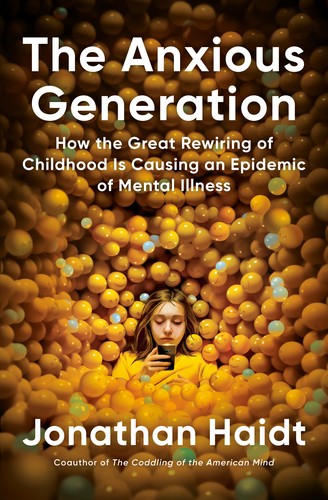
In short
Haidt's argument is that childhood was rewired between about 2010 and 2015: a play-based childhood — outdoors, unsupervised, a little risky — was replaced by a phone-based childhood built around smartphones and social media. He argues that shift is behind the sharp rise in anxiety, depression, and self-harm among teenagers, and that the fix has to be collective: four shared norms, adopted together, not family by family.
Teen mental health got dramatically worse in the early 2010s — in the United States, Britain, Canada, and the Nordic countries, all at the same time. The Anxious Generation summary, in one line: social psychologist Jonathan Haidt argues this was no coincidence. The years when anxiety and depression surged are the same years smartphones and social media moved into children's pockets. His case is built on that timing, and on what the phone took away, not just what it gave.
Key takeaways
- Haidt argues childhood was rewired between about 2010 and 2015: a play-based childhood was replaced by a phone-based one.
- He groups the damage into four harms: social deprivation, sleep deprivation, attention fragmentation, and addiction.
- Children were overprotected in the real world and left almost unprotected online, he argues.
- In his account the damage falls differently: girls are hit hardest by social media, boys by gaming and porn.
- The fix is collective, not individual: four shared norms that only work if whole communities adopt them together.
The Anxious Generation summary: the Great Rewiring of childhood
Haidt's central claim is that childhood changed structurally, not gradually. For most of human history, children learned how to handle risk, conflict, and other people through unsupervised outdoor play. Then, in a few short years, that play-based childhood was replaced by a phone-based one: hours a day spent scrolling, messaging, and watching, mostly alone, mostly indoors.
His evidence is timing. Teen depression, anxiety, self-harm, and loneliness rose sharply in many countries at once, starting around 2012 — the same window in which smartphones and social media became near-universal among teenagers. That pattern is the spine of the book. It is also where the debate lives: some researchers argue the link is weaker than Haidt claims and that other factors matter too. Haidt's answer is that the cross-country timing is too sharp and too consistent to be a coincidence.
The four harms of a phone-based childhood
Haidt traces the damage to four overlapping harms. Social deprivation: screen time displaces time spent with friends in person, and online chat is a poor substitute for face-to-face contact — eye contact, tone of voice, instant feedback — which is exactly what teaches children to read other people. Sleep deprivation: once the phone moves into the bedroom, late-night scrolling eats into sleep that adolescent brains badly need. Attention fragmentation: notifications arrive hundreds of times a day, each one yanking attention away, while the adolescent brain is still building the capacity for sustained focus. And addiction: apps are deliberately designed with variable rewards and infinite scroll to keep users engaged, and young brains are the most susceptible to that design.
The deepest harm, in Haidt's telling, may be opportunity cost. Every hour on a phone is an hour not spent doing the real-world things childhood is for: playing, arguing, getting bored, taking small risks, and learning to recover from them.
Overprotected offline, underprotected online
The book's most memorable framing is a double failure. Starting in the 1990s, Haidt argues, parents and institutions became steadily more protective of children in the real world — less unsupervised play, less walking to school alone, less freedom to take small risks. At the same moment, children were handed almost unlimited freedom online, in spaces designed by adults to hold their attention.
He connects this to two modes of the developing brain. Unsupervised play puts a child in what he calls discover mode: curious, exploring, learning that the world is mostly safe and that setbacks can be handled. A phone-based childhood, with its constant social judgment and threat of public embarrassment, keeps children in defend mode instead — vigilant, anxious, afraid of being judged. A childhood spent mostly in defend mode, he argues, is a childhood that never learns confidence.
The fix: four norms that only work together
Haidt's answer is not a parenting tip but four collective-action norms: no smartphones before high school, no social media before age 16, phone-free schools, and far more unsupervised independence and free play in the real world. The first three subtract the phone; the fourth adds back what childhood lost — and without the addition, he argues, the rest is wasted.
The key word is collective. A single family that delays a smartphone leaves its child the odd one out, so Haidt argues the norms only work when whole schools and communities adopt them together — backed, where needed, by laws and school policies. He points to the growing number of phone-free schools and age-restriction laws as proof the shift has already begun.
Who should read this book
Parents and teachers first — especially anyone raising or teaching children born after 2010. It is also worth reading for adults who recognize their own attention and sleep in these pages: the four harms are not limited to teenagers. If you want a calm, evidence-based case for giving childhood back its freedom, this is the book that makes it.
The takeaway
Haidt's message is not that phones are evil or that the past was perfect. It is that childhood is a developmental project with requirements — real play, real friends, real sleep, real risk — and the phone-based childhood fails to meet them. The fix he proposes is simple, unglamorous, and collective: delay the phone, protect the school day, and give children back the freedom to play. Whether or not you accept every part of his case, the question he leaves behind is hard to ignore: what is childhood for, if not for learning to live in the real world?
Our verdict
An important, unsettling book that changed how schools and parents talk about phones — and the rare argument that has already moved real policy. The evidence is contested, and Haidt sometimes argues more forcefully than the data allows, but the core question he raises is one every parent should sit with. Our rating: 4.5/5.
Try this today: Put your phone to charge outside the bedroom tonight — and notice how your sleep changes.
If you want to go deeper on this theme, The Body Keeps the Score, Why We Sleep, and Four Thousand Weeks are the natural next reads.
Frequently asked questions
What is The Anxious Generation about?
Jonathan Haidt argues that childhood was rewired between about 2010 and 2015, when a play-based childhood was replaced by a phone-based one — and that this shift is behind the sharp rise in anxiety, depression, and self-harm among teenagers.
What are the four harms Haidt describes?
Social deprivation, as screen time displaces time with friends in person; sleep deprivation, from phones in the bedroom at night; attention fragmentation, from constant notifications; and addiction, as apps are designed to keep still-developing brains hooked.
What are the four norms Haidt proposes?
No smartphones before high school, no social media before age 16, phone-free schools, and far more unsupervised independence and free play. Haidt stresses they only work if adopted together, by whole communities — not family by family.
Is The Anxious Generation controversial?
Yes. Some researchers argue the link between phones and teen mental illness is smaller than Haidt claims, and that other factors matter too. Haidt's case rests mainly on timing: teen mental-health problems and smartphone use rose sharply together, in the same years, across many countries.
Who should read The Anxious Generation?
Parents, teachers, and anyone raising or teaching children — especially kids born after 2010. It is also useful for adults who want to understand their own phone habits and attention.
Want the full book?
This summary covers the core ideas — the full book goes much deeper with stories, research, and detail.
Get The Anxious Generation on AmazonAs an Amazon Associate I earn from qualifying purchases.
Your turn
Which idea from this book hit you hardest — and what will you do differently this week because of it? Join the discussion under our 60-second video on YouTube.
Discuss on YouTube
Comments
Share what you thought of this book — good or bad. Sign in with a free GitHub account to comment.
Want a different book summarized? Suggest it here.