The Courage to Be Disliked Summary
🔊 Listen to this summary
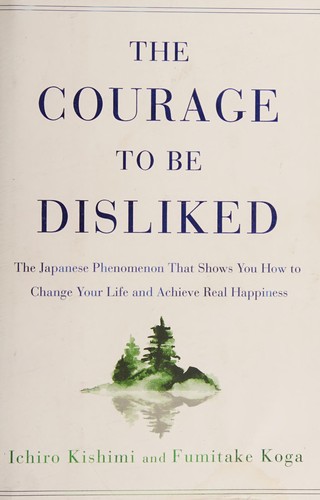
In short
Ichiro Kishimi and Fumitake Koga present Alfred Adler's psychology as five nights of dialogue between a philosopher and a young man. The argument is radical: your past does not determine your future, all problems are problems of relationships, and happiness is a choice you make in the present — starting with the courage to be disliked.
What if everything you blame on your past is actually a choice you are making right now? The Courage to Be Disliked summary, in one line: you are not pushed by what happened to you, says Alfred Adler — you are pulled by the goals you have chosen, and you can choose different ones today.
Key takeaways
- Adler rejects Freud's cause-and-effect: you are pulled by your goals, not pushed by your past.
- All problems are interpersonal relationship problems — alone in the universe, you would have none.
- Separation of tasks: figure out whose task it is, then stop interfering in others' tasks and stop letting them interfere in yours.
- Feelings of inferiority are normal and useful; an inferiority complex is using them as an excuse not to act.
- Happiness comes from community feeling — seeing others as comrades and contributing to them — and from living in the here and now.
The Courage to Be Disliked summary: your past is not your prison
The book opens with its most shocking claim: trauma does not exist. Adler's point is not that bad things never happened to you. It is that no past experience, in itself, causes your present unhappiness. Freud's model — etiology — says the past explains the present. Adler's model — teleology — says behaviour has a purpose right now, and the past is the story you tell to justify it.
The philosopher gives a sharp example: a person who stays indoors because of anxiety is not a victim of their past. They have the goal of not going out, and anxiety is the tool they create to achieve it — it protects them from rejection and excuses them from trying. Your 'lifestyle', the pattern of thoughts and actions you live by, is something you selected — and something you can re-select at any point. That is the whole point of the book: the past does not decide your future unless you let it.
All problems are interpersonal relationship problems
Adler's second radical claim is that every problem you have is, at root, a problem between you and other people. If you were the only being in the universe, the philosopher argues, you would have no problems at all — no inferiority, no anxiety about being judged, no fear of rejection.
Feelings of inferiority are part of that picture, and Adler treats them as normal and healthy: they are what push you to grow. The trap is the inferiority complex — turning ordinary self-doubt into a fixed excuse. 'I can't do this because of my background, my looks, my education' is not a diagnosis; it is a life-lie, a story you use to avoid the challenge. The young man in the dialogue admits he hates himself, expecting sympathy. The philosopher refuses it: hating yourself is useful, because if you avoid relationships, nobody can hurt you.
Separation of tasks: the key to freedom
The book's most practical tool is the separation of tasks. When a problem appears, ask one question: who ultimately receives the result of this choice? That person owns the task. If a child does not study, the poor grades land on the child — studying is the child's task. A parent can offer support, but commanding them to study is intervening in someone else's task.
The same rule cuts the other way: whether someone likes you is their task, not yours. Your task is to live in a way that matches your values; their opinion of you is theirs to hold. Most of our suffering, the book argues, comes from carrying other people's tasks — and from letting them carry ours. Put each task back with its owner, and the weight drops away.
Community feeling: happiness is contribution
The final nights turn from freedom to happiness, and Adler's answer is not what most self-help books promise. Happiness does not come from praise, status, or being liked. It comes from community feeling — seeing other people as comrades rather than rivals, and contributing to them. Your sense of worth, in this view, is not something you earn by being impressive; it is something you feel when you are useful to others.
That means relating to people horizontally, as equals, instead of vertically — above or below, praising or being praised, competing or submitting. And it means living in the here and now: the past is a story you keep retelling, and the future is shaped by what you choose today. The courage to be disliked is not about being rude or contrarian. It is the courage to live by your own principles, contribute what you can, and accept that some people will dislike you for it — and to call that freedom.
Who should read this book
Anyone stuck blaming their past for their present, and anyone whose life is organised around being liked. It hits hardest for people-pleasers, perfectionists, and readers who have tried every productivity and mindset book without changing. It pairs naturally with Man's Search for Meaning and Meditations — three very different books that agree on one thing: you are freer than you think.
The takeaway
Your past is not a prison sentence, other people's opinions are not your task, and happiness is not a prize for being impressive. Decide what your principles are, do your own tasks, contribute to the people around you, and live in the present. That takes courage — the courage to be disliked — but it is the only freedom on offer, and it starts the moment you stop asking for permission.
Our verdict
A strange, brilliant book — a philosophy dialogue that reads like an argument with your own excuses. The 'trauma does not exist' claim is deliberately provocative and will annoy some readers, and the dialogue format can feel staged at times. But the separation of tasks alone is worth the price, and the final chapters on contribution quietly reframe what happiness is for. Our rating: 4.5/5.
Try this today: Pick one worry today and ask: 'Whose task is this?' If the result lands on someone else, hand it back and do your own task instead.
If you want to go deeper on this theme, Mindset, Man's Search for Meaning, and The Let Them Theory are the natural next reads.
Frequently asked questions
What is The Courage to Be Disliked about?
A dialogue between a philosopher and a young man, over five nights, presenting Alfred Adler's psychology: your past does not determine your future, all problems are problems of relationships, and happiness is a choice you make in the present — starting with the courage to be disliked.
What does 'trauma does not exist' mean in the book?
Adler's claim is not that bad things never happened to you. It is that no past event determines how you live now — you choose the meaning you give your experiences, and you can choose a different meaning at any time. The book calls this teleology: behaviour is pulled by present goals, not pushed by past causes.
What is separation of tasks?
Adler's key practice: figure out whose task something is by asking who ultimately receives the result, then stop interfering in other people's tasks and stop letting them interfere in yours. Whether someone likes you, for example, is their task — not yours.
Who was Alfred Adler?
An Austrian psychotherapist and contemporary of Freud who founded Individual Psychology. The Courage to Be Disliked is based on his theories, as explained by philosopher Ichiro Kishimi, a specialist in Adlerian psychology, and writer Fumitake Koga.
What does 'the courage to be disliked' actually mean?
Living according to your own principles without needing everyone's approval. The book argues that true freedom requires accepting that some people will dislike you for it — and that seeking universal approval is what keeps you trapped.
Want the full book?
This summary covers the core ideas — the full book goes much deeper with stories, research, and detail.
Get The Courage to Be Disliked on AmazonAs an Amazon Associate I earn from qualifying purchases.
Your turn
Which idea from this book hit you hardest — and what will you do differently this week because of it? Join the discussion under our 60-second video on YouTube.
Discuss on YouTube
Comments
Share what you thought of this book — good or bad. Sign in with a free GitHub account to comment.
Want a different book summarized? Suggest it here.