The Four Agreements Summary
🔊 Listen to this summary
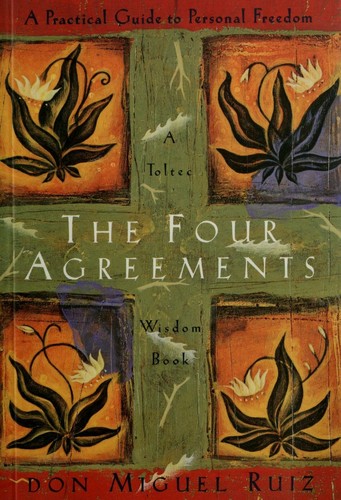
In short
Don Miguel Ruiz offers four agreements — drawn, as he presents it, from Toltec wisdom — as a code for personal freedom. Most of our suffering, he argues, comes from old agreements we made with ourselves, with others, and with society: beliefs about who we are and what we are worth that we never chose. Replace them with these four, keep them daily, and you stop creating needless suffering for yourself. The book is short, simple, and has stayed on bestseller lists for decades.
Ruiz starts with a picture of how we are raised. As children we absorb the rules of the world around us — what is good and bad, what is possible, what we are worth — until those rules become the voice in our own head. He calls this shared set of rules "the dream of the planet": a dream we did not choose, enforced by the fear of being punished and the hope of being rewarded. The Four Agreements summary, in one line: you cannot change the dream, but you can change the agreements you live by — and four of them are enough.
Key takeaways
- Most of your suffering comes from agreements you made long ago — with yourself, with others, and with society.
- Be impeccable with your word: speak with integrity, and stop using words against yourself or others.
- Don't take anything personally: other people's words and actions are about their own reality, not yours.
- Don't make assumptions: ask questions and communicate clearly instead of guessing.
- Always do your best — and accept that your best changes from day to day.
The Four Agreements summary: 1. Be impeccable with your word
The first agreement is the most important, and the hardest. Your word is the power you have to create — and Ruiz means that literally: words shape what you believe about yourself and others. To be impeccable with your word means to speak with integrity, to say only what you mean, and to avoid using words against yourself or against anyone else.
In practice this means two things most of us fail at daily: stop the gossip, and stop the self-criticism. Gossip is using your word to spread poison about people who are not there. Self-criticism is the same poison aimed inward — the voice that says you are not smart enough, not good-looking enough, not enough. Ruiz argues that the words you repeat to yourself become the agreements you live by, so the first freedom is to choose them carefully.
2. Don't take anything personally
The second agreement follows from the first. Nothing other people do is because of you. What they say and do is a projection of their own reality — their own agreements, their own fears, their own dream. When someone insults you, they are speaking from their world, not describing yours.
This is not about becoming cold or uncaring. It is about refusing to hand other people the power to decide how you feel. If you do not take things personally, you cannot be hurt by a careless comment, and you cannot be hooked by flattery either. The opinions of others stop being a verdict on your worth and become what they are: information about the person speaking.
3. Don't make assumptions
Most of our conflicts, Ruiz argues, come from assumptions. We assume others think like we do, assume we know what they meant, assume we know what will happen — and then we act on the assumption as if it were fact. We take things personally on the basis of a story we invented, then suffer over a misunderstanding that never needed to happen.
The cure is simple and awkward: ask questions. Say what you want clearly, and ask for what you want clearly. Clear communication, Ruiz says, is the only way to avoid the drama that assumptions create. It takes courage, because asking means risking an answer you do not like — but the alternative is living inside a story that may not be true.
4. Always do your best
The fourth agreement makes the other three possible. Your best is not a fixed standard — it changes with your health, your mood, your circumstances. On a good day your best looks like one thing; on a sick or exhausted day it looks like something else entirely. The agreement is simply to do your best under the conditions you are actually in, whatever they are.
Done honestly, this agreement ends two kinds of suffering at once. If you truly did your best, there is nothing to regret — no self-judgment, no "I should have done more." And because your best changes, the agreement also protects you from overworking yourself in the name of perfection. Do your best, and then let it go.
Who should read this book
Anyone exhausted by overthinking, people-pleasing, or replaying conversations in their head at 2 a.m. It is especially powerful for readers who take criticism hard, assume the worst about what others think, or beat themselves up for not being perfect. At about 140 pages it is one of the shortest books on this site — and one of the most re-read. No spiritual background is needed; the book speaks plainly to anyone who wants a calmer mind.
The takeaway
Be impeccable with your word.
Four rules, kept daily, can end most of the suffering you create for yourself: speak with integrity, take nothing personally, make no assumptions, and do your best. Simple to understand, a lifetime to practise — and worth starting today.
Our verdict
Short, simple, and surprisingly hard to live by — which is exactly the point. It reads in an afternoon and echoes for years; the second agreement alone is worth the price. The spiritual framing will not suit everyone, but the advice works whether or not you buy the Toltec backstory. Our rating: 4.5/5.
Try this today: Ask one question instead of making one assumption.
If you want to go deeper on this theme, Meditations, The Power of Now, and The Courage to Be Disliked are the natural next reads.
Frequently asked questions
What are the four agreements?
Be impeccable with your word; don't take anything personally; don't make assumptions; always do your best. Ruiz presents them as a code of conduct for personal freedom.
What is Toltec wisdom in The Four Agreements?
Ruiz presents the four agreements as based on the teachings of the Toltec, an ancient people of southern Mexico. The book is a self-help book, not a history — the Toltec framing is how the author presents his ideas.
Is The Four Agreements a religious book?
No. It's a spiritual self-help book. It draws on Toltec teachings as the author presents them, but it belongs to no church or denomination, and readers of any faith — or none — read it the same way.
How long is The Four Agreements?
About 140 pages. It's a short book you can read in an afternoon — though the agreements themselves take a lifetime to practise.
Why is The Four Agreements so popular?
It spent over a decade on the New York Times bestseller list, helped by Oprah Winfrey's endorsement in 2001, and has sold around 15 million copies in the United States. Its appeal is its simplicity: four rules, no jargon, and advice that works in everyday life.
Want the full book?
This summary covers the core ideas — the full book goes much deeper with stories, research, and detail.
Get The Four Agreements on AmazonAs an Amazon Associate I earn from qualifying purchases.
This summary shares a book’s ideas for general education only.
Your turn
Which idea from this book hit you hardest — and what will you do differently this week because of it? Join the discussion under our 60-second video on YouTube.
Discuss on YouTube
Comments
Share what you thought of this book — good or bad. Sign in with a free GitHub account to comment.
Want a different book summarized? Suggest it here.