The Millionaire Next Door Summary
🔊 Listen to this summary
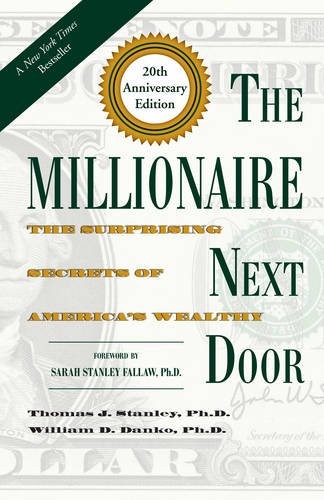
In short
The Millionaire Next Door is the result of two decades of research into how Americans actually become wealthy, and its finding upends the stereotype: most millionaires are not celebrities, heirs or high-spending professionals, but ordinary, frugal people who live well below their means, save and invest steadily, and value financial independence over looking rich. Stanley and Danko, who began studying the affluent in 1973, surveyed and interviewed hundreds of millionaires and distilled seven common traits, plus a simple formula for judging whether you are accumulating wealth fast enough for your age and income. The book's core message is that wealth is what you accumulate, not what you spend — and that the habits that build it are available to anyone willing to practise them.
Can you spot the millionaire on your street? In The Millionaire Next Door, Thomas J. Stanley and William D. Danko argue that you almost certainly cannot — because most American millionaires live in ordinary houses, drive used cars and wear modest clothes, and the people who look rich are often the ones with the least actual wealth.
Key takeaways
- Wealth is net worth, not income. A high salary with high spending builds nothing; what matters is what you keep and accumulate over decades.
- Most millionaires are first-generation rich. Around 80 percent built their wealth themselves rather than inheriting it, usually through disciplined saving, investing and business ownership.
- Live well below your means. The book's millionaires budget carefully, spend modestly on cars, clothes and watches, and treat frugality as a habit, not a punishment.
- Know your number. Expected net worth equals your age multiplied by your pre-tax annual household income, divided by ten; prodigious accumulators of wealth are worth twice that or more, under-accumulators half or less.
- Financial independence beats status. The wealthy in the study consistently chose freedom and security over displaying high social status — and they taught their children to be economically self-sufficient rather than subsidising them.
The millionaire you would never notice
The book opens by demolishing the image of wealth sold by advertising: the mansion, the luxury car, the designer wardrobe. Stanley and Danko's research found the opposite. The typical millionaire in their studies lives in a middle-class neighbourhood, has lived in the same house for years, drives a car several years old, and has never spent more than a few hundred dollars on a suit or a watch. Self-employed people make up less than 20 percent of American workers but account for about two-thirds of millionaires, and most millionaires are business owners or self-employed professionals rather than corporate executives. The point is not that these people are secretly miserable misers — it is that their spending is disciplined and deliberate, and their wealth is invisible precisely because it was never spent on display.
This matters because the stereotype does real damage. If you believe wealth looks like luxury, you will spend your way toward the appearance of wealth and away from the reality of it. The authors show that high-income white-collar professionals — doctors, lawyers, corporate managers — are among the worst accumulators, because their incomes fund lifestyles that consume everything they earn. The book's most useful distinction is between the "income affluent," who earn a lot and keep little, and the "balance-sheet affluent," whose net worth is high regardless of how impressive their income looks.
PAWs, UAWs and the wealth formula
Stanley and Danko give readers a simple diagnostic: the Under Accumulator of Wealth (UAW) has a low net worth relative to income, while the Prodigious Accumulator of Wealth (PAW) has far more than expected. Their rule of thumb is to multiply your age by your realised pre-tax annual household income from all sources except inheritances, divide by ten, and subtract any inherited wealth — that is roughly what your net worth should be. A PAW is worth about twice that expected figure or more; a UAW is worth half or less. The formula is crude, and the authors say so — it works best for older people who have been earning longer — but as a reality check it is brutally effective, and it is the part of the book readers quote most.
The seven common traits the authors found among successful accumulators tie the formula together: they live well below their means; they allocate time, energy and money efficiently; they value financial independence over displaying high social status; their parents did not provide regular economic support; their adult children are economically self-sufficient; they are good at targeting market opportunities; and they chose the right occupation. Notice what is not on the list: inheritance, genius, luck or a huge salary. The list is a set of behaviours and choices, which is why the book has stayed popular — it makes wealth feel like something you do, not something you are.
Frugality as a system, not a sacrifice
The middle of the book is a close look at how millionaires actually spend — and the details are deliberately unglamorous. They budget, and not casually: the authors found that millionaires spend far more time planning their finances and investments than the average household, and that the foundation of wealth accumulation is defence — budgeting and planning — rather than offence, meaning earning more. They invest a significant share of their income each year, hold a meaningful portion of their wealth in publicly traded stocks and mutual funds, and are willing to take calculated financial risks when the reward justifies it. They are not, the authors stress, misers hiding cash under mattresses; they are fastidious investors.
Frugality extends to the household, and the authors are blunt about the role of a spouse: in their research, the most successful accumulators were often married to partners who were even more frugal than they were, and they warn plainly that it is very hard to become wealthy in one generation if you are married to someone wasteful. The shopping habits of UAWs, by contrast, explain their empty balance sheets: luxury goods and status items absorb the income that could have become wealth. The tone here can feel judgemental to modern readers, but the data behind it is the book's backbone — two decades of surveys, not anecdotes.
Family, children and the inheritance trap
The final chapters deal with the most uncomfortable finding in the book: that generous parents often destroy their children's wealth. Stanley and Danko call regular financial gifts to adult children "economic outpatient care," and argue that it teaches dependence, inflates lifestyles beyond what the children can sustain, and leaves them less capable of accumulating wealth themselves. Their adult children, the successful millionaires insist, are economically self-sufficient — taught the value of money, discipline and hard work rather than subsidised into comfort. The authors observe that UAWs tend to raise children who need regular infusions of parental money to maintain the lifestyle they expect, passing the pattern to another generation.
This is also where the book shows its age most clearly. Its data comes from 1990s America, its households are mostly traditional two-parent families, and its advice assumes a world of stable careers, affordable housing and employer pensions that looks distant in 2026. The principles — spend less than you earn, invest the difference, teach your children to do the same — survive the time gap, but the specific numbers, occupations and spending examples are historical artefacts. Readers should take the framework seriously and the details as a snapshot of its era.
Who should read this book
Anyone who earns a decent income yet feels no richer at the end of the year will find this book uncomfortably useful, as will young professionals deciding how to spend their first good salaries. It is also essential reading for parents thinking about how much financial help to give adult children, and for anyone who suspects that looking wealthy and being wealthy are two different things.
The takeaway
The Millionaire Next Door proves, with twenty years of data, that real wealth is usually invisible: it is built by ordinary people who live below their means, invest steadily and refuse to buy status. The formula is simple and the habits are learnable — the hard part is sticking to them for decades.
Our verdict
A landmark, data-driven classic whose core insight — wealth is what you keep — has never been refuted. It loses points for dated data and a narrow, 1990s-American picture of family and work, and some of its judgements about spending read as stern today. Our rating: 4.4/5.
Try this today: Work out your expected net worth: multiply your age by your annual pre-tax household income, divide by ten, and compare it honestly with what you actually own minus what you owe.
If you want to go deeper on this theme, The Psychology of Money, The Richest Man in Babylon, and I Will Teach You to Be Rich are the natural next reads.
Frequently asked questions
When was The Millionaire Next Door published?
First published in 1996 by Longstreet Press; the widely available edition is the 20th-anniversary hardcover from Taylor Trade Publishing, 1 October 2016, with a new foreword by Thomas J. Stanley.
What is the wealth formula in the book?
Multiply your age by your realised pre-tax annual household income (excluding inheritances), divide by ten, and subtract inherited wealth. That is roughly what your net worth should be.
What is a PAW and a UAW?
A Prodigious Accumulator of Wealth (PAW) is worth about twice the expected net worth for their age and income or more; an Under Accumulator of Wealth (UAW) is worth half or less.
What are the seven common traits of millionaires?
They live below their means; allocate time, energy and money efficiently; value financial independence over status; received no regular economic support from parents; have self-sufficient adult children; target market opportunities well; and chose the right occupation.
Are most millionaires first-generation rich?
Yes — the book reports that about 80 percent of America's millionaires are first-generation rich, having built their wealth themselves.
How many copies has the book sold?
By 1998, the book had sold 2 million copies, according to the author biography in Google Books; it spent more than a year on the New York Times bestseller list.
Want the full book?
This summary covers the core ideas — the full book goes much deeper with stories, research, and detail.
Get The Millionaire Next Door on AmazonAs an Amazon Associate I earn from qualifying purchases.
Your turn
Which idea from this book hit you hardest — and what will you do differently this week because of it? Join the discussion under our 60-second video on YouTube.
Discuss on YouTube
Comments
Share what you thought of this book — good or bad. Sign in with a free GitHub account to comment.
Want a different book summarized? Suggest it here.